Wednesday, March 16, 2011

Cross country flight to the green wall

Here are a few photos from my birthday this year. Elli took me on a beautiful cross country flight to the "green wall."

The view of the terraced fields below us.

The green wall, a steep and lush hillside.
The ridges of the green wall extend out ahead of us.
For a while we were flying with a Himalayan griffon vulture.
You can see him at the top of the frame behind us.
The griffon vulture flew just above our wing here.
Our shadow over the green wall.  
The last photo I took of our altitude, just as we got over 3.000 meters. 
This was us at 3200 meters as we were on our way back.
Coming out over the lake; Maya Devi is in the middle of the bay.

Monday, February 14, 2011

Egyptian vultures


I have spent the last few months getting to know two amazing Egyptian vultures. I thought you might want to get to know Egyptian vultures as well.
Kevin, an Egyptian vulture in adult plumage
Bob, a 3 year old Egyptian vulture,
still in mostly juvenile plumage.

Egyptian vultures are native to northern Africa, as their name would suggest, but they are also found in southern Europe across the Middle East and Asia to India and Nepal. They tend to prefer hilly and dry habitats, and nest on cliff ledges.

While other vulture species are seen in large groups, Egyptian vultures tend to be seen either solitary or in pairs. Often a mated pair may remain together outside of the nesting period, a trait unusual for raptors.
Kevin coming in to land after a Parahawking flight.
Kevin landing, you can just see my outline at the right of the photo.
Weighing 3 to 4 pounds with a 5 to 5.5 foot wingspan, Egyptian vultures are the smallest vultures in Europe and Asia.  

Due to their small size, they aren’t often seen at large carcasses, being unable to fight the larger vultures for the food. Instead they will arrive at a carcass after the larger vultures have left, and will use their smaller beaks to pick the remaining meat from the bones. They will also eat insects, vegetable matter, eggs, and feces, and are often seen scavenging at garbage dumps. 

Vultures are probably the smartest of the raptors. (Many people think of the “wise old owl” as the smartest of birds, but just think of those large owl eyes… the eyes that take up between 50-75% of the space in an owl’s skull. The “wise old owl” is a myth.) Egyptian vultures prove their intelligence by being one of the few birds that are known to use tools. The African population of Egyptian vultures has found that ostrich eggs make a good meal. Of course the eggs are too large for the vultures to pick up with beak or talons, and the shells are too strong for them to crack easily, so the clever birds have learned to pick up a smooth rock in their beaks and throw it at the egg until the shell cracks.
 
Bob picking up a chicken egg and throwing it on the ground to crack it. 
Kevin and Bob, the two Egyptian vultures at Himalayan Raptor Rescue, are fed chicken eggs as a treat. These eggs, they quickly figured out, are small enough to pick up with their beaks. To get at the food inside these eggs, they just need to pick up the egg and drop it on the ground until it cracks.  
Bob has just cracked the shell and gotten inside the egg.
The trick is dropping the egg gently enough that the contents aren’t splattered all over the ground, but hard enough that the shell cracks. Kevin, at 5 years of age, has mastered the technique. It only takes him one or two tries until the shell is cracked just enough that he can then get his beak inside. Bob, at 3 years of age, is still working on his egg-cracking skills. A year ago, he would crash every egg into the ground, and then spend ages slurping up as much of the contents from the ground as he could. Now he is over-compensating, and dropping each egg so gently on the ground that it takes him longer to open the egg than to eat it. He will soon get the hang of it, and be a master egg opener, just like Kevin.

Ancient Egyptians revered Egyptian vultures because of their intelligence, as well as their important role of cleansing the environment of carcasses. The vultures were associated with royalty and with Egyptian goddesses such as Isis and Mut, and were often referred to as the Pharaoh’s chicken. They were the first protected species, as the Pharaoh respected them to such an extent that he made killing an Egyptian vulture punishable by death.

Despite the ancient Egyptians’ best efforts, today Egyptian vultures are listed as Endangered species. They are vulnerable to pollution, poisoning and electrocution from power lines, and - as with many other vultures in Asia - they are declining due to the veterinary drug diclofenac. Diclofenac has been banned for veterinary use since 2006 in Nepal, India and Pakistan, and hopefully we will soon see a rise in Egyptian vulture populations again in these areas.

Kevin and Bob are great ambassadors, showing that vultures deserve our respect and admiration for what they do, and helping spread the word about the vulture crisis in Asia. 


Thursday, February 3, 2011

Chitwan National Park

“Wait! Stop!” Our guide for our jungle trek stops in his tracks, and then frantically motions us to move back behind the tree. We back-up oblingingly and wait quietly. Chitwan National Park, with its rhinoceros, elephants, tigers and sloth bears, is not the type of place where you want to charge ahead of your guide. We can hear something large slowly moving through the grass ahead of us. We can’t see the source of the noise, as the grass is named elephant grass for a reason: it is tall enough to hide an elephant.
Shh, there's something ahead in the grass
All we can do is stand by the one tree big enough to provide us some protection and wait. We watch the rustling grass move closer to the opening of our trail, until we are able to make out an ear through the grass, then the rest of the animal comes into view, and we find ourselves facing a one-horned rhinoceros.
Our first glimpse...
One-horned rhinoceros
It is a unique experience to be face to face with such a large animal (rhinos can get to well over 6,000 lbs) with no protective fencing in between. The advice our guide gave us at the start of our jungle walk was to either climb or hide behind a tree if we came across a rhino. The one large tree nearby wasn't climbable, and wasn't quite large enough to fit all 7 of us behind it. As the large animal lumbered onto the path, it turned towards us and regarded us for a moment. Rhinos are known for their poor eyesight, and if this one perceived us as some type of threat, it could easily charge. I held my breath, we took photos, and soon it decided we were of no interest and it continued its slow grazing walk. 

This was on the first morning we were in Chitwan National Park, but this was not the first rhinoceros we saw in Chitwan. The night before, after checking into our hotel and getting some food, we took a walk around the town of Sauraha - the tourist base for visiting the park. As the sun started dropping low across the terai, we saw a group of people gathered at the river, and we went over to see what they were looking at. A large rhino was grazing on some grass just across a branch of the river. He was completely ignoring the crowd of people staring and taking photos of him, just enjoying his evening meal. 
One-horned rhinoceros who was hanging out just across
the river from the main section of town on the night we arrived.

We saw four of the endangered one-horned rhinoceros during our 3 days in Chitwan. After malaria was eradicated in the 1950s, and people started moving to Nepal's terai region in droves, Chitwan's rhinos became the victims of poaching and their populations dropped to less than 100. They were the reason for the creation of Nepal's first national park. The populations were steadily increasing until the Maoist takeover caused a near elimination of park patrols. From a high in 2000 of over 600 rhinos, today there are around 400 rhinos in the park. Poaching patrols have started again, and the numbers are again increasing. 
The third rhinoceros we saw over 3 days -
we didn't get a photo of the fourth
Then of course, there were all the other wild animals we saw. Nepal is one of the most biodiverse countries in the world, containing 10% of the world's species. Chitwan National Park is one of the most biodiverse areas in Nepal. Over the course of 3 days, and from a jungle trek, jeep safari and elephant safari, we saw a number of animals. Here are some of them...
Marsh mugger crocodile
Oriental pied hornbill
Spotted deer
Rhesus macaque
Crested serpent eagle
Gharial - a strange looking crocodile
We didn't see any wild elephants in Chitwan, although they are found there, but we had a number of elephant encounters.  The first night we were there, we came across one of the working elephants who was in his shelter for the night. His caretakers were making snack balls for him, grass wrapped around a chewy filling. We asked if we could feed him, and were each handed one of the finished snack balls. As I approached the elephant, he lifted his trunk and gently took the snack ball from my hands.

Feeding the elephant

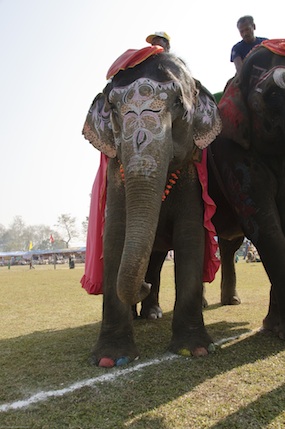
We also inadvertently timed our visit to coincide with the International Elephant Races. We were able to catch one of the final races. All the elephants are decorated with chalk and paint and different colored banners. They line up at the starting line, and wait fairly patiently for the gun to fire. Then they run. If you've never seen an elephant run, it is somehow very comical. Watch the movie below to see. You can also see how seriously Nepalis take their elephant races!
At the 7th Annual International Elephant Races
Waiting at the starting line
Decorated and ready to run


Another elephant encounter we had during our time in Chitwan, was a visit to the Elephant Breeding Center. You are able to go there and interact with the baby elephants until mid-morning, at which time they take all the elephants to the jungle to feed. We didn't make it out to the breeding center until mid-morning, and were told we were too late, the elephants are gone, we should come back in late afternoon when they return from the jungle. We started to walk back the way we came, but then we saw a line of elephants of all ages leaving from the back of the center and making their way to the river. Of course, we followed them. We walked along with the elephants, including one very playful younger elephant who was running along and trumpeting the whole way. We watched them drinking and bathing in the river, before they headed off to the jungle.
Sean making friends with a baby elephant near the
Elephant Breeding Center
I'm sure I could have spent another full week in Chitwan and still not have seen everything. I would love to visit there again!

Sunday, January 30, 2011

Rescue Mission

I've been here for three and a half months, and we've just had our first potential new bird at Himalayan Raptor Rescue. A man came to Maya Devi, and said he's had an owl in a chicken crate for the past 10 days, and we needed to come look at it. After clarifying that we're a rescue center and we can take the owl, but will not pay him for it, we piled in a taxi with some gloves and a cardboard box for transporting the bird.

We drove to a house in the middle of farm fields. There was a simple cow shelter in the back, and a lean-to outdoor kitchen off the side door. When we went inside, we found an overturned wooden crate on the landing of the concrete stairway. Underneath, on the concrete floor, was a Eurasian eagle owl.

The crate on the concrete stair landing where the owl was being held. 
Then the negotiations began. In Nepal, there isn't a widespread feeling of goodwill towards wildlife. People wouldn't just pick up an injured bird to rescue it for the bird's sake. They will pick up a bird, if they think they can sell it and make a good amount of money from it.

The people who found this owl had seen an article in the paper, where birds like this one could be sold for lots of money. Although we had repeatedly said we would not pay for the bird, they kept saying we needed to give them money; 50,000 Nepali rupees (over $700). Soon, we found ourselves surrounded by everyone who lived in the area. They all came in support of this family with the owl, and against these white foreigners who clearly had plenty of money and were just trying to get the owl for free.

We argued with them as much as we could with the help of our taxi driver/translator. We told them their options: we could either take the bird now, take care of it, then release it to the wild, or the Forestry officers would come and take the owl, and then fine them for keeping it. They chose to take their chances, and after hours of trying to reason with them and getting yelled at and laughed at in return, we left empty-handed. The man who had originally told us about the owl gave us the evil eye as we left, believing the whole time that we would eventually come around and pay him the money for the owl, and then we reneged on our "deal."

As we rode back to Maya Devi in the taxi with the empty cardboard box, I was feeling frustrated with the situation and our inability to reason with the people. I was feeling overwhelmed with being surrounded by so many angry and greedy people. I was feeling helpless and lost in a country where the norm is so far from what I am used to. Mainly, I was feeling sorry for the owl, who did nothing to deserve being trapped in a crate for almost two weeks.

The Forestry Officer went to the house the next morning, and the owl was no longer there. It was either moved to a different location, or sold, or just released. In any case, I will remember that owl and will be hoping for the best for him.


Tuesday, November 30, 2010

What is it like to fly?

This question has been asked by people all over the world for generations. We look up into the sky with awe at the birds soaring above us, and we wonder how it feels to be up there looking down at the ground far below.

"House thermal" over the ridge behind Maya Devi.

 Paragliders have come the closest to finding out the answer to this age-old question. On a regular basis, paraglider pilots lift off from mountain-tops and soar and circle in thermals high above the earth. 

At the take-off.
A good day for flying.
Just run, then fly.

View of Phewa Tal from the glider.
Those are my knees. 


Views from the glider.
Looking back toward the take-off point.
The Annapurna range is just behind those clouds.


Coming in to land.
Maya Devi can be seen at the center of the photo.
Sign at the take-off.
Paragliders are quite aware of the birds they share the sky with.


With Parahawking, this is taken one step further. You are not only soaring in the air, sharing the same thermals as the birds, the masters of the air, but you are sharing the experience with a bird. 

The birds, two Egyptian vultures and a black kite, are trained to come in to the gloved hand on cue, and in the air. They follow along behind the glider and wait for their cue, a two-note whistle, then they come down to land briefly on the out-stretched arm – just long enough to eat a piece of food from the glove – and then they just open their wings to lift effortlessly off the glove and start soaring again.
 
Kevin in the taxi. Yes, a taxi.
How else would you get to the take-off site?
Bob waiting to take off.
A glider wing laid out on the ground, also ready to take off. 

Elli, a Parahawking pilot, with passenger, and Bob the vulture
following behind her glider a little bit to the left. 

Parahawking with Kevin and Elli.
I've been working with birds on a daily basis for a number of years now, but I've never come this close to to feeling like a bird myself. With parahawking, you are getting a glimpse into a bird’s life that has long been closed to us. You see how easy it looks for them to open their wings and glide off your hand. You see their feathers moving in the wind, and how the slightest movement of their wing or feathers will cause a change in direction or height.  You see their slight head movements as they focus on the different gliders or other birds in the air. You feel the minimal weight on your hand as they land. You see the ground from a bird's eye view.There is nothing to compare it to. You just have to come to Nepal, and try it for yourself!